

Contents

Is there an FE Exam for International Students?
What if you live outside the United States – is there still an option to take the FE Exam? Or do you need to travel to the US?
In this resource, we will tackle this common question, and what, if anything, you need to do to ensure you prepare adequately and are ready to pass the FE Exam.
Let’s get into it.
What is the FE Exam?

The Fundamentals of Engineering Exam (FE Exam) is one of two exams that an engineer will take in the process of becoming a licensed Professional Engineer.
This standardized exam is administered and scored by the National Council of Examiners for Engineering and Surveying (NCEES) and adopted by each state’s Professional Engineering Board as a valid means of ensuring individuals desiring to practice engineering are competent to practice.
The exam is made up of 110 questions that span a wide range of foundational engineering concepts, in which, you will have 5 hours and 20 minutes to complete.
Each question is developed to confirm the level of competency of the individual in the fundamentals of engineering.
The FE Exam is computer-based and closed book, though, each examinee is granted the use of two tools:
- An NCEES-approved calculator, which isn’t a graphing calculator, but can be the most powerful, yet underutilized tool used on the FE Exam.
- The NCEES FE Reference Handbook containing commonly used formulas and other useful information related to the material that is covered.
The FE Exam has 7 different exam specifications that one can choose from, though all lead to the same ends – becoming an Engineering Intern (or EIT) in your respective state.
You can take the exam year-round in four different testing windows, which are:
- January – March
- April – June
- July – September
- October – December
You are allowed to take the FE Exam once per testing window, but not more than 3 times in a 12-month period from the date of the first attempt.
To illustrate this, if you were to take the exam for the first time on January 21st, 1776 and fail, you could take the exam again in the next testing window, which would be somewhere between April and June.
Say you then take the exam again on May 3rd, 1776 and fail – you will again, be able to take the exam in either the July to September, or October to December testing window.
Now say that you take your third attempt at the exam on July 4th, 1776 and fail.
This would be your third failed attempt in a 12 month period from your first attempt and you wouldn’t be eligible to retake the exam until January 22nd, 1777, which is 12 months and 1 day after your first attempt.
As you are learning more about the FE Exam, you may also hear it referred to as the EIT Exam (Engineer In Training Exam) or the EI Exam (Engineering Intern Exam), all of which are the same exam.
Can I take the FE Exam as an International Student?

While primarily offered in the United States, the NCEES does provide the FE Exam for International Students.
The NCEES has partnered with Pearson VUE testing centers to offer the FE exam internationally.
If there is a Pearson VUE test center that offers NCEES exams in your country, or a nearby country, you could potentially take the FE exam there.
Because availability of the FE Exam for International Students is ever-evolving, and there may be additional requirements or restrictions for international test-takers, it’s important that you check with the NCEES directly for the most current information regarding international testing locations, fees, and scheduling.
You can find the most recent information here.
Before getting too much in to the details, you should do two things to ensure your eligibility for taking the FE exam as an International student.
The first is to do an ABET accredited program search.
If your program is accredited, then applying for the exam should be fairly streamlined, if not, then you will need to do one more step prior to applying.
You can do an ABET accredited program search here.
Because international licensure candidates typically have degrees from programs that are not accredited by EAC/ABET, most United States licensing boards require candidates to have their academic credentials evaluated through NCEES Credentials Evaluations (or other acceptable entity).
The current cost to have your degree evaluated through the NCEES is $350 and will be paid at the end of the application process.
You can learn more about NCEES degree evaluations here.
How do I register to take the FE Exam as an International Student?

Though each individual scenario will be unique, the general process of registering to take the FE Exam as an International student is as follows:
- Visit the NCEES website
- Create an account or log in if you already have one
- Check for the availability of international test centers
- Follow the instructions provided by NCEES to register for the exam at your chosen location
- Remember to also verify with the engineering board of the state in which you wish to be licensed to ensure they accept an FE exam result that is taken internationally, as each state may have different rules and requirements
This last point is very important.
The FE Exam is the first step in becoming a licensed Professional Engineer in a specific State within the United States.
Eligibility requirements are not set uniformly across the board by the NCEES, but rather, by each engineering Board in its respective state.
With this said, when someone is deemed eligible to take the exam in Tennessee may differ from when one is deemed eligible to take the exam in Texas.
You can review your desired State’s eligibility paths here:
Please note, eligibility requirements do change so it is best to double-check directly with your desired state board of Professional Engineers website to confirm the latest statutes.
What if I don’t have an ABET-Accredited degree?

So what if you don’t have an ABET-accredited degree?
What if you don’t have a degree at all?
Is there still an option to take the FE Exam as an International student?
Maybe.
Now the actual path to gaining eligibility in these cases will be unique to the situation, which again, I will refer you to this page to hone in on the specifics for your desired state.
However, there are often multiple paths to gaining eligibility to take the FE Exam defined by each state.
The ABET-accredited degree is obviously the golden ticket when it comes to gaining eligibility, but it’s not the only route.
Let’s take Alabama as an example.
The Alabama Board of Professional Engineers has established a nice flowchart outlining the various paths to gaining eligibility:
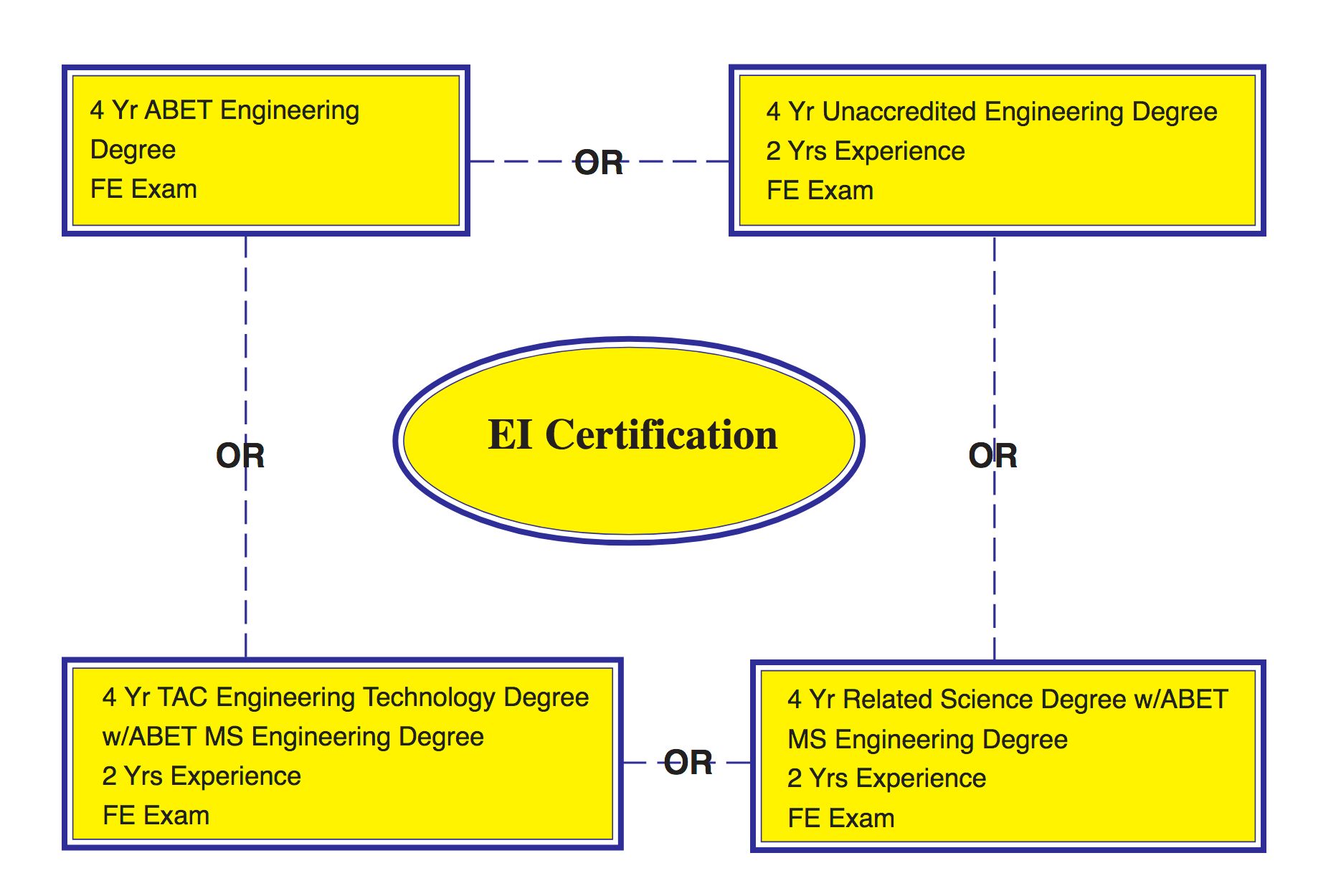
As you can see, everything starts from an ABET-accredited degree and adds on from there.
If one has an unaccredited, TAC or unrelated science degree (plus an ABET MS in the latter scenarios), then an additional 2 years of progressive engineering experience would be required.
You can view this entire flowchart and associated Alabama requirements here.
Now, let’s look at Texas as another example of how each state defines unique minimum eligibility requirements.
In section 133.65 Examination on the Fundamentals of Engineering in the TBPELS Acts and Rules found here, the following is stated:
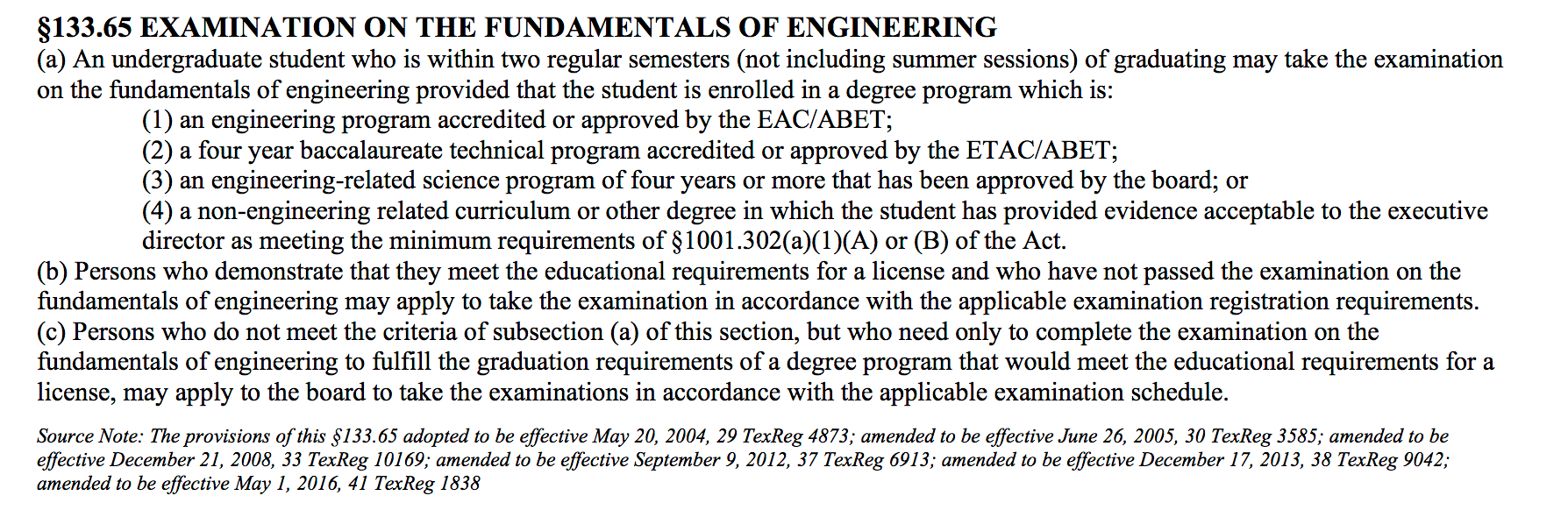
In Texas, all EAC/ABET, ETAC/ABET, engineering-related and non-engineering related programs can lead one to eligibility, albeit, with those last two scenarios having some additional verification requirements attached.
So again, as an international student, understanding the actual path to gaining eligibility is critical to wanting to take the FE Exam.
Is the FE Exam online?

The FE Exam is not online.
It will be taken at a local Pearson Vue testing center in your country.
Once you register and are approved by the NCEES to take the exam, you will receive an email giving you the next steps in scheduling your exam appointment.
Through this process, you will be given options for a number of testing centers as well as the dates and times available at those locations.
You can reference a current list of locations approved by the NCEES to take the FE Exam in your country here:
Can I take the FE exam near me?

If you intend to work as an Engineer in the United States, the FE exam for International students is a solid first step to take – and you don’t need to travel to the United States to take it.
The National Council of Examiners for Engineering and Surveying (NCEES), which administers the FE Exam, has authorized Pearson VUE testing centers in various countries, allowing candidates from around the world to take the exam.
The NCEES currently has agreements in place with the following foreign entities to administer the FE Exam.
- Alberta, Canada (APEGA)
- British Columbia, Canada (EGBC)
- Egypt (AUC)
- Egypt (EES)
- Emirate of Sharjah (AUS)
- Japan (JPEC)
- Korea (KPEA)
- Manitoba, Canada (Engineers Geoscientists Manitoba)
- New Brunswick, Canada (APEGNB)
- Nova Scotia, Canada (Engineers NS)
- Prince Edward Island, Canada (Engineers PEI)
- Qatar (TAMUQ)
- Saskatchewan, Canada (APEGS)
- Saudi Arabia (SCE) – Engineering
- Saudi Arabia (SCE) – Surveying
- Taiwan (CIE)
– NCEES currently in discussions with Engineers PEI to administer the FE Exam
Each approved entity is linked so that you are able to get more detailed and specific information detailing how to take FE Exam in your country.
How hard is the FE Exam?

So as an international student, how hard is the FE Exam going to be?
As we tell all those who ask this question, we would be blowing smoke if we claimed that we could objectively answer this for you.
The difficulty of the FE Exam differs for everyone based on so many uniquely personal factors.
Some (but not all) of these factors include:
- What is your educational background?
- How long have been out of school?
- What are your current responsibilities? (family, work, etc)
- Have taken the exam before?
- When do you want to take the exam?
- How much time do you have for studying?
- How do you typically perform on timed exams?
So how hard is the FE Exam going to be for you?
I couldn’t tell you.
But what I can tell you is this.
If you relate to any of these scenarios:
- Have historically been a horrible test taker
- Have battled low confidence and wondering if you have the capability to pass.
- Have been out of college for over 35+ years.
Then we can help you prepare for and pass the FE Exam, because these are actual stories of past students.
You can read more of these Prepineer success stories here.
But the point isn’t to applaud our program, it’s to illustrate that it doesn’t matter how “hard” you think it’s going to be, it’s establishing where your current level of commitment in getting it done is.
We have seen time and time again, that it’s not a matter of knowledge, it’s a matter of will – that’s what will ultimately get you past the FE Exam.
So with all that being said, let me lay out some general statistics.
There is not one state (or country) that releases individual statistics for how many individuals are passing or failing the FE Exam in any given period of time.
However, the NCEES keeps a tally of these statistics for a single testing period for the population as a whole.
Currently, the FE Exam pass rate ranges from 35% to 83% depending on the exam discipline taken.
This is a wide range, and honestly, can’t be relied on for a number of reasons.
These statistics account only for:
- Those who took the FE exam for the first time.
- Those who attended an EAC/ABET-accredited engineering program.
- Those who took the FE exam within 12 months of graduation.
I can tell you this much –
Of 100 students that come into our program at Prepineer, 95 will fall outside one (or more) of these criteria.
The moral of the story, these stats reflect a population of individuals who meet the ideal testing characteristics of a candidate, not the mean characteristics as a whole.
Use them with a grain of salt.
So just know, again, that this exam is designed to ensure that those involved in engineering are qualified and able to maintain high standards when they gain engineering licensure.
It has to be challenging, just like our weed-out classes in college.
But knowing that, and expecting that, should give you a leg up when hitting the obstacles that you are sure to hit along the way.
Those that persevere can, and will, conquer the FE Exam and the PE Exam.
It doesn’t matter how hard it will be.
How do I study for the FE exam?

As you learn more about taking the FE Exam for International students, you will realize just how much needs to get done and how important preparing for it the right way is.
I am confident in saying that you can get this done…
But truth is, most won’t pursue the FE Exam because they will tell themselves that they can’t, for one reason or another.
At Prepineer, we have put together a proven system of coaching and material review that has helped even the most challenged individuals study for and pass the FE Exam.
If we offered to help you do the same thing, would you take it?
Click here to learn more about how Prepineer simplifies studying for the FE exam and get started for free.
In Prepineer you will:
- Get a real coach who knows how to get you to the finish line, despite how impossible you may think it is.
- A custom study plan that breaks down exactly where you should be spending your efforts.
- Proven material that has helped even the most challenged find success.
Use Prepineer for 7 days free, with no obligations.
Final thoughts: Is there an FE Exam for International Students?

So is there an FE Exam for International Students?
Yes.
But again, this is a unique situation that presents a diverse set of requirements depending on where you will ultimately be taking it. To make sure that you are clear on the latest eligibility paths for your country, see the links provided in this resource.
For US state specific requirements, this resource was put together to ensure you get all the answers to the questions you are asking:
Knowing whether or not you can take the FE Exam as an International student is one thing, preparing for it is a whole’nother beast.
Preparing for the Fundamentals of Engineering Exam isn’t a cram-by-night and get-it-done type of journey.
This isn’t written to scare anyone away from pursuing their goal of becoming a licensed Professional Engineer.
It’s more to set the expectations and give over a decade of experience of what works after being on both sides of the coin ourselves.
At Prepineer, we believe that personal coaching, mentoring and accountability aren’t just some good things to have in place –
They are must-haves.
They smooth out the struggles, the doubts and the uncertainties, giving you clear direction and energy to sustain through them all.
If passing the FE Exam has felt like a mountain of a task, we are here to help you change that and find success.
Click here to see how personal coaching can help you make the dream of becoming a PE a reality.